
Treatment protocols make good choices easy for customers
Patient counselling based on medical science is the basis of all operations at Terveystalo. Patient counselling is being developed based on common treatment protocols, and the first treatment protocol related to non-specific low back pain will be introduced in October. The purpose is to increase the effectiveness of the treatment the customer receives and to assist and speed up recovery and return to work.
The treatment protocols are treatments defined by Terveystalo, based on the Current Care Guidelines, to treat a given illness or ailment for which a customer seeks treatment. With their help, uniform treatment of a specific ailment is ensured in Terveystalo’s nationwide network, which guarantees consistent quality and the realization of effective treatment.
“Treatment protocols clarify and streamline the professional’s work. When the diagnosis-specific care pathway is strengthened with the help of automated alerts, the appointment can focus on the encounter and the things that bring added value to the customer,” says Antti-Jussi Ämmälä, Senior Physician, Quality and Patient Safety at Terveystalo.
“For example, the treatment protocol for low back pain includes physical therapy. When you record low back pain in the patient information system, a referral for physical therapy can be made very easily,” says Ämmälä.
Terveystalo’s responsibility is to support the customer in various ways. By developing digital solutions, ways are sought to remind and be in active contact with the customer if it seems that the next steps of the treatment will not be done. We also support self-care by bringing information about the ailment and its self-care into the app.
“Through our expertise, we know what things should happen for an effective treatment to take place and for the patient who is to be treated to get help for their ailment as soon as possible. Our job is to make sure that these things actually happen so that a minor ailment does not turn into a long-term health problem that causes sickness absences. When a referral for further treatment has been made, the customer receives a message through which they can immediately book the appointment. If the customer does not book an appointment, we first remind them gently and then more briskly,” explains Ämmälä.
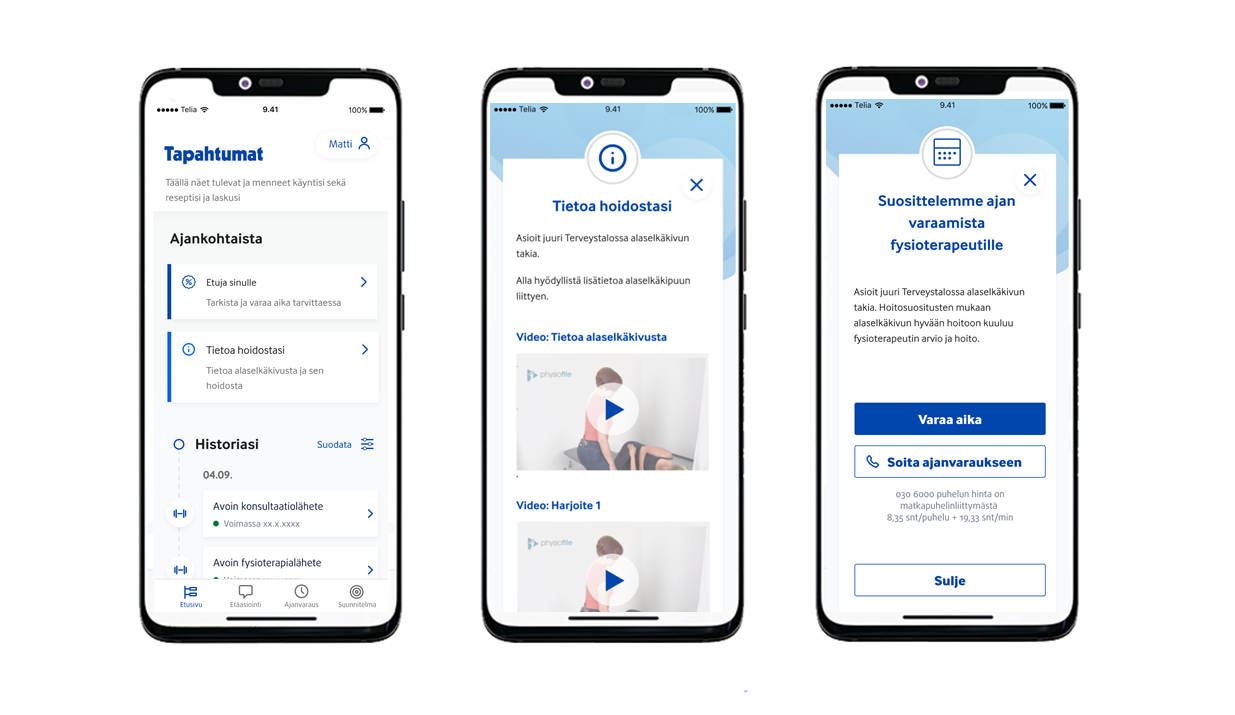
In the future, researched information related to the diagnosis and support for self-care will be distributed widely to customers through the Terveystalo app. Now, at the latest, you should encourage your personnel to use the app.
“One of the expert’s tasks is to share information about the customer’s ailment. It may not always be possible to take in all the information during an appointment, so we make it easy for customers to return to the information. Through the Terveystalo app, we share additional information about treatment, articles and, for example, physical therapy instruction videos,” says Ämmälä.
At the end of 2022, Terveystalo will also introduce treatment protocols for occupational health customers prepared for the treatment of depression, anxiety and sleep disorders, as well as treatment protocols for vitreous detachment and acid reflux.
Latest articles
New appointments to Terveystalo’s occupational health leadership team – Ilse Rauhaniemi named Chief Occupational Health Physician
Ilse Rauhaniemi, a specialist in occupational health, will join Terveystalo as the new Chief Medical Officer of Occupational Health effective April 1, 2026. She will be responsible for the medical leadership of Terveystalo’s occupational health services, the quality of care, and service development. In addition to Rauhaniemi, the medical leadership of occupational health will be strengthened by two new experts: in March and April, Tomi Ylä-Soininmäki and Tuula Angervuori-Pursila will begin working as senior occupational health physicians focused on the development and effectiveness of occupational health.
Digital trends in healthcare 2026: The ability to leverage artificial intelligence comprehensively will become a key success factor
The accelerating development of technology and artificial intelligence doesn’t just mean new innovations in healthcare; it forces us to rethink the entire operating logic of the sector, says Ilari Richardt, Head of Digital Services at Terveystalo.
Members of the occupational health team share their insights: effective occupational health is achieved through collaboration
Everyday occupational health work is multifaceted, and providing information and services that create value for clients requires ever-closer collaboration between different professional groups. At Terveystalo, occupational health services are delivered by multidisciplinary teams of experts. When experts from different fields work together and know each other as well as the client, collaboration runs smoothly and creates lasting added value for the client.
Healthy Work Life Barometer 2026: Growing workload poses a challenge to the workplace; the solution lies in a sense of community
The Healthy Working Life Barometer 2026* reveals that 48% of business decision-makers consider the Finnish working life to be healthy. This is an encouraging turn for the better, as it represents a 5-percentage-point increase from the previous year. At the same time, the barometer reveals a new normal in the workplace: as many as 80% of respondents feel that the Finnish workplace is more fast-paced and stressful than ever before.
Healthy Work Life Barometer 2026: A positive trend in health, but a growing gap in views on humanity between top management and other employees
The Healthy Working Life Barometer 2026* reveals that 48% of business decision-makers consider the Finnish working life to be healthy. This marks an encouraging shift for the better, as it represents a 5-percentage-point increase from the previous year. Although the overall picture of workplace health has improved, experiences regarding management’s proactiveness and the humanity of everyday work vary, so polarization between roles is on the rise.
Occupational health Therapies at the Forefront – operating model reformed mental health support for staff in Oulu
Mental health and behavioral disorders were a cause for concern in the city of Oulu. Sick leave was on the rise, and the phenomenon was evident not only in statistics but also in the everyday life of work communities. When the Therapies to the Forefront operating model became available for occupational health services, Oulu seized the opportunity. The goal was to build a completely new way of thinking about mental health support and to provide tools for every employee to promote their own well-being and coping. The achievements of the first six months show that the solution was the right one: a 10% decrease in mental health absences is the result of a comprehensive cultural change.