

Environmentally sustainable consumption
Environmental policy and ISO 14001:2015 certified environmental management
Terveystalo’s environmental policy describes the environmental principles that all employees, managers, officers, board members, consultants, and other personnel under the leadership of the Terveystalo Group are expected to adhere to. Terveystalo operates in accordance with sustainable development principles to prevent and reduce harmful impacts on the environment. In addition to the Group's environmental policy, Terveystalo is committed to fully complying with applicable laws, regulations and industry practices that ensure work and patient safety, and to continuously improve environmentally friendly practices.
Terveystalo’s long-term environmental goals include, among other things:
- The development of environmental management and awareness at all organisational levels
- Increasing awareness of environmental impacts arising from our daily activities
- Identifying, anticipating, minimising environmental impacts, maximising positive environmental impacts, and transparently monitoring direct and indirect environmental impacts
- Developing and implementing practices that promote and ensure sustainable development
Read more about Terveystalo's sustainability management here: Ethical Business
Terveystalo's ISO 14001 certified environmental management system covers all healthcare services segment locations (a total of 185 locations) in Finland, and its appropriateness is assessed through quality and environmental system audits. ISO 14001 is an international standard for environmental management that helps us systematically identify, manage, and reduce our direct and indirect environmental impacts. In other locations, the same practices and environmental system are followed, although they are not directly within the scope of the certification. Each location prepares its own annual environmental programme, which is regularly monitored by the environmental system's operational working group. Locations and Terveystalo staff are regularly trained on environmental responsibility, and best practices are shared through common communication channels. In Sweden, 90% of Feelgood's controlled locations are also certified according to ISO 14001.
Terveystalo recognises, manages, and prevents its environmental impacts through the following measures:
- Reducing energy consumption and transitioning to lower-emission energy sources
- Reducing the amount of waste generated by our operations and increasing our recycling rate
- Optimising the life cycle of healthcare equipment considering technological advancements
- Taking environmental considerations into account in travel and car policies
- Developing digital services and digital interactions
- Planning and implementing pharmaceutical management in a timely manner
- Incorporating environmental considerations in centralised procurement and ensuring efficient inventory management
- Considering sustainable development and environmental aspects in network and business premises projects
Circular economy and artificial intelligence boost performance and improve care
An excellent practical example of circular economy thinking in our operations is our factory-serviced MRI equipment, which has been thoroughly refurbished. Refurbished devices and updated systems are smart, sustainable, and medically high-quality solutions that also support our climate and environmental goals.
Terveystalo's climate work
Terveystalo’s environmental work has progressed in recent years in line with the principles of continuous improvement. At the end of 2024, Terveystalo enhanced its emissions calculation to be more comprehensive and, for the first time, calculated its indirect Scope 3 emissions based on procurement, covering all significant categories. In early 2025, Terveystalo became the first healthcare operator in Finland to commit to setting science-based near- and long-term emission reduction targets in accordance with the Science Based Targets initiative (SBTi). The targets were approved by SBTi in the summer of 2025.
Terveystalo’s Climate Transition Plan serves as the company’s highest‑level guiding document for climate work and for advancing more sustainable healthcare. The Climate Transition Plan brings together the company’s current state of climate work, targets and actions. The Climate Transition Plan was approved in 2025 by Terveystalo’s ESG and Quality Steering Group. The Climate Transition Plan is updated regularly, at least annually, and it examines the direct and indirect impacts of climate change on the company’s business operations and value chain. The Climate Transition Plan is available for download and review here: Terveystalo Climate Transition Plan 2025–2050.
In 2025, Terveystalo reported on its environmental work in accordance with the EU Corporate Sustainability Reporting Directive (CSRD) and the European Sustainability Reporting Standards (ESRS). The reported environmental standards were E1 – Climate Change and E5 – Resource Use and Circular Economy. The information can be found in the Sustainability statement section of the Annual Report on pages 72–163.
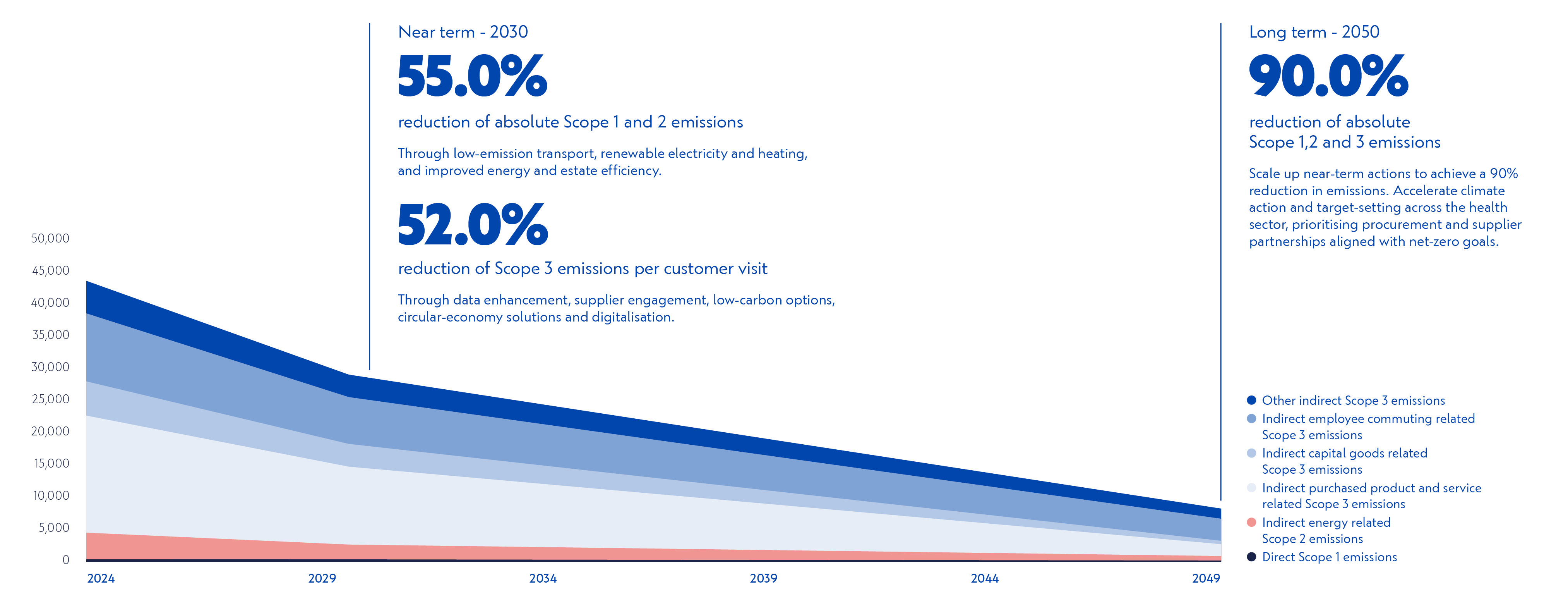
Terveystalo is the first Finnish healthcare service company to commit to reach the net-zero greenhouse gas emissions across the value chain by 2050. In the near term, Terveystalo commits to reduce absolute Scope 1 and 2 GHG emissions 55% by 2030 from a 2024 base year. Terveystalo also commits to reduce Scope 3 GHG emissions 52% per thousands of customer visits within the same timeframe. For the long term, Terveystalo commits to reduce absolute Scope 1 and 2 GHG emissions 90% by 2050 from a 2024 base year. Terveystalo also commits to reduce absolute Scope 3 GHG emissions 90% within the same timeframe. The targets include land-use change emissions and removals associated with bioenergy feedstocks.
Read more about the Science Based Targets initiative here: Science Based Targets initiative. 
Terveystalo’s Carbon Footprint
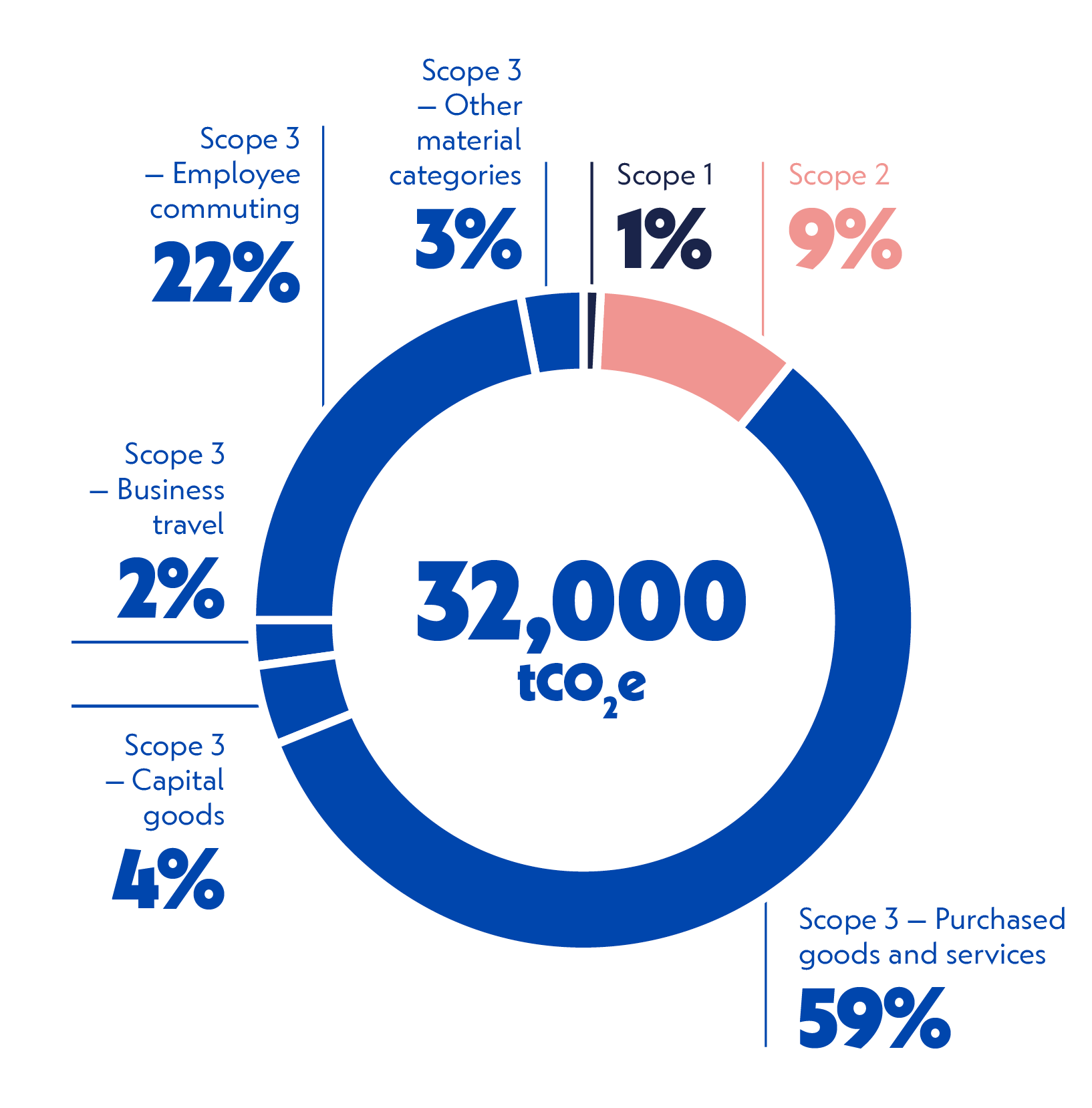
Based on the 2025 calculations, direct Scope 1 emissions accounted for 1% of total emissions, indirect Scope 2 emissions for 9%, and Scope 3 emissions for 90%. The assessment shows that the largest climate impacts arise indirectly through activities at the upstream end of the value chain. Total emissions include Scope 1, 2 and 3 categories as defined by the GHG Protocol, as well as biogenic emissions. The emissions calculation has been verified by an independent third party.
Scope 1
Scope 2
Indirect Scope 2 emissions arise from the energy consumption of Terveystalo’s facilities. Of the emissions related to purchased electricity, 89% and, for heating, 52% have been calculated using primary data. Scope 2 emissions are calculated using both the location‑based and market‑based methods, with calculations performed annually for each site. Market‑based Scope 2 emissions in 2025 amounted to 2,883 tCO₂e. In Finland, a total of 13,400 (11,900) MWh of green electricity was purchased for the 2025 consumption year, corresponding to approximately 83% (69%) of the company’s electricity consumption in Finland. A total of 2,690 (4,660) MWh of non‑green electricity was purchased, corresponding to 1,090 (2,630) tCO₂e (market‑based) Scope 2 emissions in Finland. In 2025, an estimated 11% of the heating used at Finnish sites was renewable. In Sweden, properties managed by Feelgood purchased 1,765 (1,750) MWh of electricity, of which approximately 81% (80%) was green electricity. Market‑based Scope 2 emissions from purchased electricity in Sweden amounted to 28 (23) tCO₂e.
Scope 3
For indirect Scope 3 emissions, Terveystalo reported and considered the following material categories according to the GHG Protocol:
1. Purchased goods and services
2. Capital goods
3. Fuel- and energy-related activities (not included in Scope 1 or Scope 2)
4. Upstream transportation and distribution
5. Waste generated in operations
6. Business travel
7. Employee commuting
8. Upstream leased assets
13. Downstream leased assets
15. Investments
Materials used and waste
In the healthcare sector, waste generation is inevitable, as hygiene and safety are of paramount importance in operations. Therefore, the methods to reduce waste focus mostly on specific measures, such as life cycle management, packaging materials, improving recycling options for non-urgent care, and reducing waste. Terveystalo aims to minimise the generation of mixed waste in all company operations and to deliver as much waste as possible for reuse.
A key theme in Terveystalo's environmental responsibility is the recycling and reuse of waste, with the goal to minimise the generation of mixed waste in all Terveystalo operations and to deliver as much waste as possible for reuse. Terveystalo is committed to reducing plastic waste generated by its operations in accordance with the EU's plastic strategy, by improving recycling and reviewing supplier packaging options whenever possible. Separate waste collection is crucial for Terveystalo's environmental goals. Terveystalo also closely monitors its pharmaceutical waste, which is reduced by improving inventory management. There are situations in Terveystalo's operations where safety and hygiene must take precedence over waste reduction and reuse.