
Members of the occupational health team share their insights: effective occupational health is achieved through collaboration
Everyday occupational health work is multifaceted, and providing information and services that create value for clients requires ever-closer collaboration between different professional groups. At Terveystalo, occupational health services are delivered by multidisciplinary teams of experts. When experts from different fields work together and know each other as well as the client, collaboration runs smoothly and creates lasting added value for the client.
In a multidisciplinary team, the company’s situation is examined from multiple perspectives simultaneously. This helps identify root causes and develop solutions that have a lasting impact beyond a single visit or intervention.
– When we genuinely examine the company’s situation together, a whole new level of understanding emerges. For the client, the value of the multidisciplinary approach is particularly evident in how the specialized expertise of different professional groups is better utilized for the client’s benefit, explains Lotta Salo, a registered dietitian from Seinäjoki.
Smoothness, continuity, and proactivity are evident to the client
As part of client-centered development, over the past year we have tested a new way of organizing the work of occupational health teams at some of our locations. In practice, this has sometimes meant that the team structure has been reviewed and some of the occupational health team professionals have changed. The goal of these changes has been to ensure that each of our client organizations has access to an occupational health team with the broadest possible range of skills and expertise.
Based on feedback, the experiences from these pilot projects have been positive: collaboration has gone smoothly, information flow has improved, and client work has become more proactive. Our goal for this year is to roll out the practices proven effective in the pilot projects nationwide.
For cooperation to run smoothly, it is essential that the multidisciplinary team be permanent, that collaboration be a daily occurrence, and that there be established structures in place. A shared team, sometimes spanning multiple locations, facilitates substitutions, facilitates information sharing, and ensures that expertise isn’t dependent on a single person.
– Even in unpredictable and unexpected situations of change, information isn’t lost, and there are always people who understand the client’s situation. Information isn’t fragmented, and the flow of information isn’t interrupted. This turns collaboration into a partnership rather than simply ordering and providing a service, explains Noora Leppänen, a senior occupational health physician in Turku.
The multidisciplinary approach is also well-suited to increasing understanding of what kind of expertise the client benefits from most at any given time.
– Every professional has their own passions, which they have explored more deeply and specialized in, such as smoking cessation, sleep disorders, or even the specific needs of agricultural entrepreneurs. We are able to respond more comprehensively to the challenges companies face, and no single expert needs to know everything, because when working in a larger team, help is available from a colleague when needed. This contributes to a greater sense of control over work, improved quality, and better collaboration from the perspective of both professionals and clients, explains occupational health nurse Tiina Kujala from Lapua.
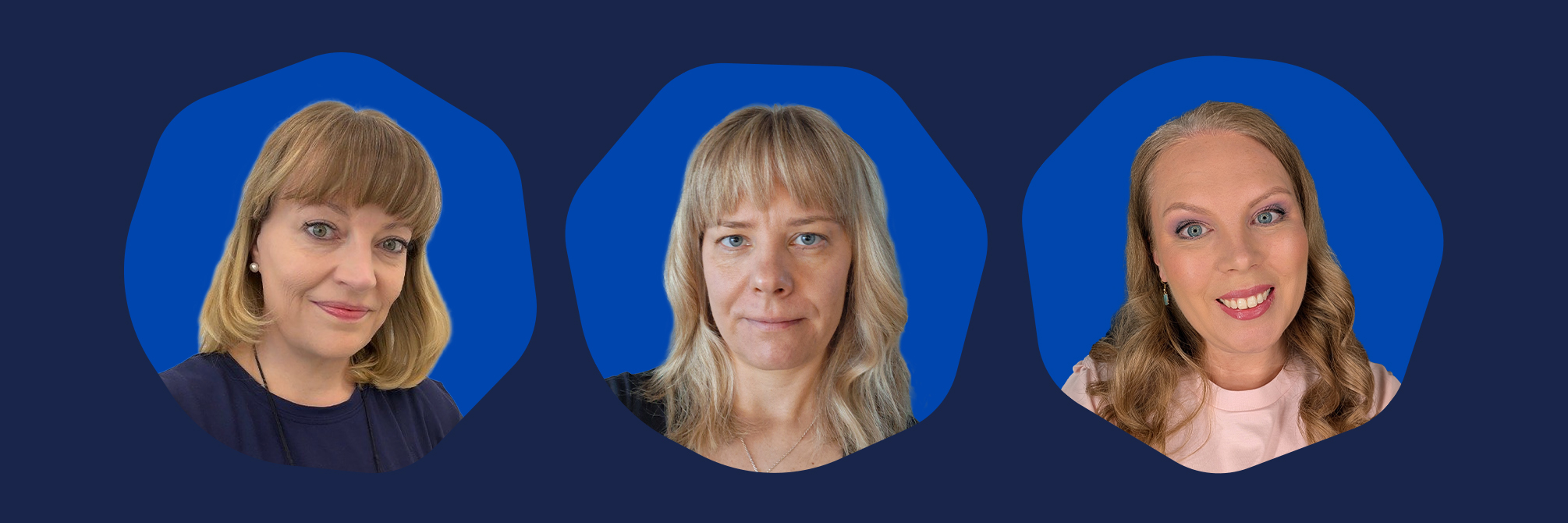
Photo: Tiina Kujala, Lotta Salo, and Noora Leppänen
When a multidisciplinary team understands the client’s situation and knows each other well, collaboration is consistent and proactive. In such cases, occupational health genuinely supports the organization’s day-to-day operations and goals.
– A multidisciplinary approach is a way to work smarter and more humanely. For us, this model has helped make time management and the division of labor more cost-effective, for example, by considering which professional group handles which task. At the same time, it has increased understanding that sharing responsibility improves both the quality of work and well-being at work, Leppänen summarizes.


